

The counterintuitive truth about scale: it’s not the size of the deal that slows things down—it’s the size of the thinking behind it
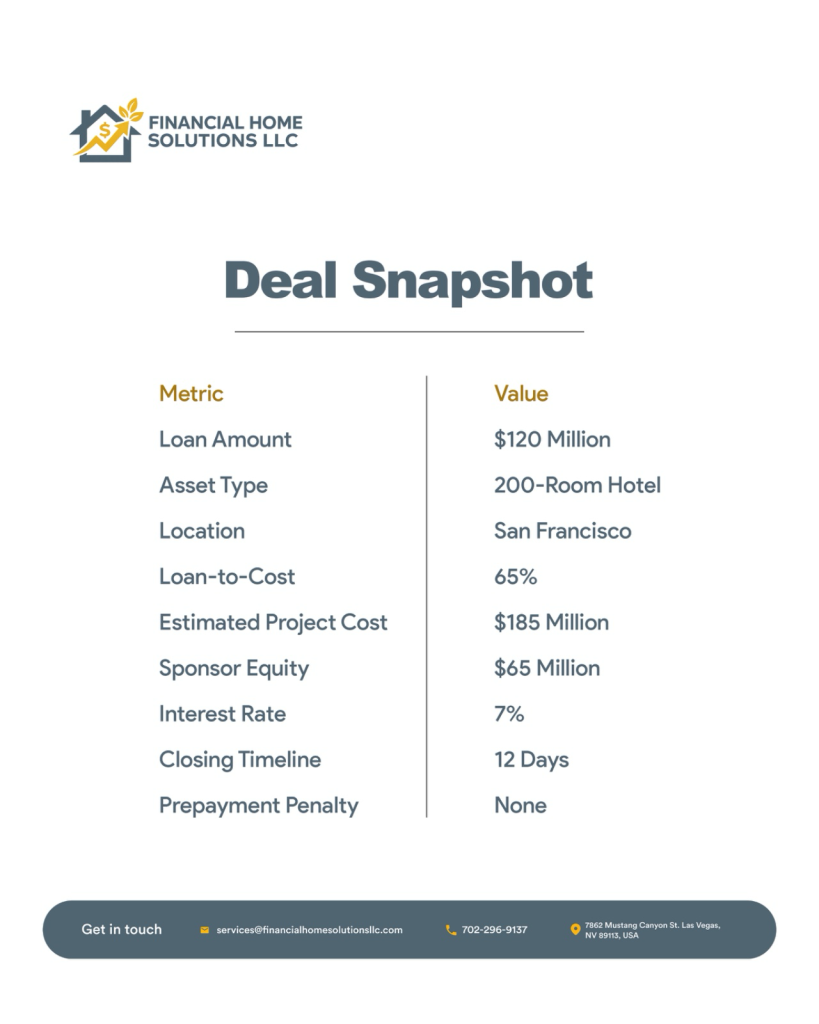
In twelve days, Financial Homes Solutions LLC funded a $120 million construction loan for a 200-room hotel in California. It went from term sheet to funding in that window. Not twelve weeks. Not a long underwriting cycle. Twelve days.
Most people assume that’s an exception. It isn’t. At this level, speed is normal when the deal is structured correctly. Delay is what shows up when it isn’t.
Small Thinking Creates Slow Deals
Walk into a traditional lending process with a weak or incomplete deal and the process stretches immediately. More documents. More committees. More hesitation. Not because the numbers are complex, but because the lender can feel the gaps. And gaps always slow capital down.
Now compare that to this deal: fully entitled site, complete construction drawings, experienced sponsor, general contractor already in place, and roughly 65% loan-to-cost structure. The lender wasn’t being asked to speculate. They were being asked to fund execution already in motion.
That changes everything.
Speed doesn’t come from urgency. It comes from removing uncertainty before underwriting even begins.
Why Banks Keep Saying “We Need More Time”
This deal had already been in front of a bank three times. Each time the answer was the same: “we need more time.” That wasn’t a comment on the asset. It was a comment on the system.
Banks move at consensus speed, not deal speed. And consensus is always slow. Internal credit committees, risk management layers, regulatory compliance reviews — each one adds days or weeks regardless of how clean the deal actually is. Banks are not designed to move fast. They are designed to move safely, and those are two very different objectives.
What often gets lost in that process is that the borrower ends up paying for the bank’s internal inefficiencies. Every extra week of delay is a week of carrying costs, a week of market exposure, and in competitive situations, a week that could cost you the deal entirely. The sponsor in this case understood that waiting for a fourth bank review wasn’t a strategy. It was a cost.
The sponsor didn’t wait for another committee cycle. They moved the deal to a capital source designed for execution, not deliberation, and the timeline collapsed to twelve days. That is the difference.
Equity Is the Language Lenders Actually Speak
A 65% loan-to-cost ratio is often described as conservative, but that misses the point. On a $185 million project, the sponsor is putting up roughly $65 million in equity. That level of skin in the game removes a major layer of lender risk before the conversation even starts. The lender is not taking first-loss exposure. The sponsor already has it.
Construction risk still exists — cost overruns, delays, market shifts — but the structure absorbs most of the uncertainty upfront. That’s what makes speed possible. Not optimism. Structure.
Here’s what most borrowers miss: lenders aren’t just evaluating the asset. They’re evaluating the sponsor’s conviction. And nothing communicates conviction more clearly than a large equity position. When a sponsor has $65 million of their own capital at stake, the lender’s confidence in the deal fundamentally changes. The conversation shifts from “can we trust this borrower?” to “how quickly can we get this funded?”
That is the psychological and financial reality of equity-heavy deals. Structure isn’t just a technical detail. It’s a signal.
Speed Is Not a Lender Feature — It’s a Deal Feature
There is a common misunderstanding around speed itself. Most borrowers think speed is a lender feature. It isn’t. Speed is a reflection of how little the lender has to think. The more questions a deal creates, the slower it moves. The fewer questions it creates, the faster it clears.
In this case, there were fewer questions. Everything was documented. Everything was defined. Everything was ready before it was requested. That is what compresses timeframes — not pressure, not relationships, not rate concessions.
This is worth sitting with for a moment. The typical borrower response to a slow close is to call the lender more frequently, escalate to a senior contact, or threaten to move the deal. None of those tactics solve the actual problem. If the deal has gaps, pressure just makes lenders more cautious, not less. The only thing that reliably accelerates underwriting is a deal that answers questions before they’re asked.
That means having your environmental reports ready. Your title work clean. Your appraisal ordered in advance. Your insurance binders prepared. Your draw schedule pre-built. None of these are exotic requirements. They are the baseline for a deal that moves fast.
The Competitive Advantage Nobody Talks About
Speed also has value in the market that goes far beyond financing cost. A twelve-day close is not just a financing outcome — it is a competitive advantage. Sellers, contractors, and partners all price in certainty. A buyer who can actually close in days instead of months changes negotiation dynamics completely.
Sellers accept lower prices from buyers who can move. Contractors prioritize clients who have their capital confirmed. Partners trust sponsors who have a track record of execution. Most sponsors never benefit from any of that because their financing process makes speed impossible by design.
Think about what it means to walk into a seller negotiation knowing your capital is confirmed and your lender can fund in under two weeks. That confidence is visible. It changes the conversation. In many cases, it closes deals that a slower buyer never could have won at any price.
What $120 Million in 12 Days Actually Proves
The takeaway is simple but easy to overlook.
You don’t get fast capital by asking for it. You get it by building a deal that doesn’t require interpretation. When the structure is clean, the equity is real, and the execution plan is already in place, capital stops behaving like a gatekeeper and starts behaving like infrastructure.
This deal didn’t move fast because Financial Homes Solutions is unusually aggressive or the market conditions were perfect. It moved fast because the sponsor came prepared, the structure was airtight, and the deal did the work that most borrowers leave to the lender.
That is how $120 million moves in twelve days. Not because the lender is fast. Because the deal is ready.
And that is the standard every serious developer should be building toward — not just for speed, but because the discipline required to prepare a deal this well is the same discipline that makes projects succeed after closing.

Financial Homes Solutions LLC specializes in large-scale construction and bridge financing for commercial real estate. If you’re working on a deal that’s ready to move, reach out to learn how fast capital can actually flow.


As a commercial borrower, I have worked with several financing groups over the years, and Financial Homes Solutions impressed me with their ability to focus on solutions instead of obstacles. Their team understands that serious projects require timely decisions. Throughout the process, communication remained clear and professional, giving us confidence that our transaction was being handled by experienced professionals. Their approach reflects an understanding of how important timing is in today’s competitive real estate market. Great Guy Richard Lederer.
Large development projects require partners who understand the value of time.
We had a $40M multifamily deal sit at a bank for 14 weeks. Moved it to a private lender with the same docs already prepared — funded in 18 days. This blog describes that experience perfectly.
I’ve been in real estate development for 22 years. The deals that move fast are always the ones where the sponsor already has their act together. This article should be required reading for first-time developers.
The part about skin in the game is underrated. When you put serious equity in, lenders stop treating you like a risk and start treating you like a partner
Many lenders talk about fast closings, but few have examples that demonstrate it at scale. Financial Homes Solutions showed that large transactions do not have to be burdened by unnecessary delays when a project is properly structured. Their ability to review, evaluate, and fund a significant commercial loan in a short timeframe reflects professionalism, efficiency, and confidence in their underwriting process. For borrowers seeking certainty and responsiveness, this type of performance is highly valuable.
From a lender’s perspective, this is 100% accurate. We’re not slow because we enjoy it. We’re slow because borrowers hand us incomplete deals and expect us to sort it out for them.”
As a real estate developer, I understand how costly delays can become during the construction phase of a project. What impressed me about Financial Homes Solutions was their ability to recognize a well-prepared opportunity and move decisively. Funding a $120 million construction loan in just 12 days demonstrates not only access to capital but also a deep understanding of the development process. Their approach appears focused on execution, which can make a meaningful difference for developers working under tight timelines and contractual obligations.
What most borrowers don’t understand: the faster we can underwrite, the more deals we can do. Speed benefits us too. Stop giving us reasons to slow down
From a lending perspective, this transaction reflects disciplined risk management rather than aggressive lending. The project was supported by a fully entitled site, complete construction plans, experienced borrowers, and substantial borrower equity. Financial Homes Solutions demonstrated that speed does not require sacrificing due diligence when a deal is properly structured. Their ability to deploy capital efficiently while maintaining a conservative loan-to-cost ratio showcases a lending model built around preparation, transparency, and execution. This is the type of transaction that professional lenders seek because the fundamentals support the timeline.
For developers and investors working on large scale projects, having a lending partner that can move efficiently while maintaining professional underwriting standards is a significant advantage.
I send this exact message to clients every week: stop blaming the lender when your deal package is missing half the documents they need
After reviewing their track record and learning about transactions such as the $120 million hotel funding, I would be interested in working with this company
I send this exact message to clients every week: stop blaming the lender when your deal package is missing half the documents they need
As a broker, I’ve seen $10M deals take longer than $100M deals. It’s never about size. It’s always about preparation
The best borrowers I work with treat the lender like a business partner, not an obstacle. Their deals always close faster
The company’s ability to evaluate opportunities efficiently is what stood out to me. They seem to understand that well-prepared projects should not be trapped in endless approval cycles.
This article is a masterclass in what separates institutional-quality borrowers from everyone else. Structure, equity, execution plan — that’s the formula
Capital moves fast when the deal is ready. Full stop
We approached Financial Homes Solutions after experiencing repeated delays elsewhere. What stood out immediately was their willingness to evaluate the merits of the project rather than endless back and forth. Their team demonstrated professionalism, responsiveness, and a deep understanding of commercial financing. It was refreshing to work with a company that values execution
This is why we require financing to be confirmed before we mobilize. Developers who have their capital sorted out make our jobs infinitely easier
After years in the lending industry, I can say that speed is rarely about rushing. It is about preparation. Financial Homes Solutions appears to recognize that principle better than many lenders and structures its process accordingly.
We’ve worked on hotel projects where financing took 6 months to close. Then we worked with a borrower who used Financial Homes Solutions and we were breaking ground in under a month. Night and day difference
We have worked with multiple financing sources over the years, and Financial Homes Solutions and Richard lederer continues to stand out because of their consistency. They maintain the same level of professionalism, responsiveness, and attention to detail on every transaction.
From a legal standpoint, this deal had everything in place: clear title, entitlements, defined structure. The legal review on a clean deal like this can move in days, not weeks
Working with Financial Homes Solutions reinforced the importance of partnering with experienced professionals. Their team appeared confident, organized, and focused on delivering results. That confidence helped create trust from the very beginning.
We found the team easy to work with. Mr Lederer was awesome
The deals where we get paid on time are always the ones where the borrowers structured their financing right from the beginning.
We were seeking a lending partner capable of understanding a large scale development opportunity, our broker recommended them
Financial Homes Solutions brings a practical mindset to commercial financing. Rather than focusing exclusively on potential problems, they appear focused on understanding how strong projects can move forward successfully. That perspective creates value for clients.
This is exactly what we experienced. Once we stopped chasing banks and started structuring deals for private capital, our timelines completely changed. 12 days isn’t a miracle though it’s what happens when you do the work upfront.
Timing can determine whether a business opportunity succeeds or fails.
What separates Financial Homes Solutions from many organizations is their apparent commitment to execution. They understand that well prepared projects deserve timely consideration and that delays can have significant consequences for borrowers and investors alike. Borrowers and Lenders are partners at the end of the day
As a broker, I value relationships with companies that deliver on their commitments. this company has a strong presence in California and Florida, making them a company I would feel comfortable introducing to clients.
Most deal delays we see on the legal side are caused by incomplete due diligence, not complexity. This article highlights that perfectly
As a repeat client, I continue to appreciate the consistency of their service. Each interaction has been professional, transparent, and solution oriented. It is reassuring to work with a company that maintains high standards across multiple transactions.
When a borrower comes to us with a fully structured deal and asks us to move fast, we can. The problem is most don’t come that way.
We were impressed by the company’s commitment to communication. Questions were answered promptly, updates were provided consistently, and expectations were clearly defined. Those qualities helped create trust and confidence throughout the financing process. I would recommend them
he 12-day timeline is impressive but not unheard of in well-structured transactions. Preparation compresses legal review just as much as it compresses underwriting.
The 12-day timeline is impressive but not unheard of in well-structured transactions. Preparation compresses legal review just as much as it compresses underwriting.
Having worked with numerous lenders, I can confidently say that Financial Homes Solutions approaches transactions differently. Their focus on structure, documentation, and readiness allows them to evaluate opportunities more efficiently than many traditional institutions. That efficiency creates value for everyone involved. Take it from me, this is the company to work with
Our organization was seeking a financing partner that understood the demands of commercial development. The comments here are encouraging
This blog could have been titled ‘How to make your attorney’s job easier.’ Every point applies to legal due diligence as much as lending.
As a passive investor, I look for borrowers who think like this article describes. If they can’t explain their capital stack clearly, I’m out.
I’ve backed sponsors who moved $100M deals in weeks and borrowers who couldn’t close a $5M deal in 6 months. The difference was always preparation, never market conditions.
The equity-in ratio described here — 65% LTC — is exactly the kind of skin in the game I want to see before I co-invest on a project
We used Financial Homes Solutions on a $28M mixed-use deal in Nevada. From first call to funded in 16 days. Their process is unlike anything we’ve worked with. I have referred 4 friends since that funding and they all have great things to say also
I was skeptical about the timeline they quoted. I shouldn’t have been. They did exactly what they said they would do. Our deal was 1M
After two failed bank attempts on the same deal in California, Financial Homes Solutions closed it in under three weeks. I only wish I’d called them first
As a broker, my reputation depends on the quality of the partners I introduce to clients. I have left every meeting with confidence which showed throughout the transaction process.
Their team actually helped us identify a gap in our structure before underwriting and fixing it is what made the deal fundable. That kind of proactive communication is rare. Good company and they fund all around the country
The biggest lesson here for beginners: your job as a developer is to remove risk before you walk into a lender’s office, not after.
If I could teach new investors one thing, it would be this: capital isn’t the bottleneck
Hotel construction financing is notoriously complex. A 12-day close on a 200-room project is genuinely remarkable and speaks to how well the deal was packaged.
I’ve been coaching real estate investors for 12 years. The ones who read content like this and take it seriously are the ones who build real portfolios
As a developer, the biggest mindset shift was realizing that slow financing is usually our fault, not the lender’s. This article nails it